

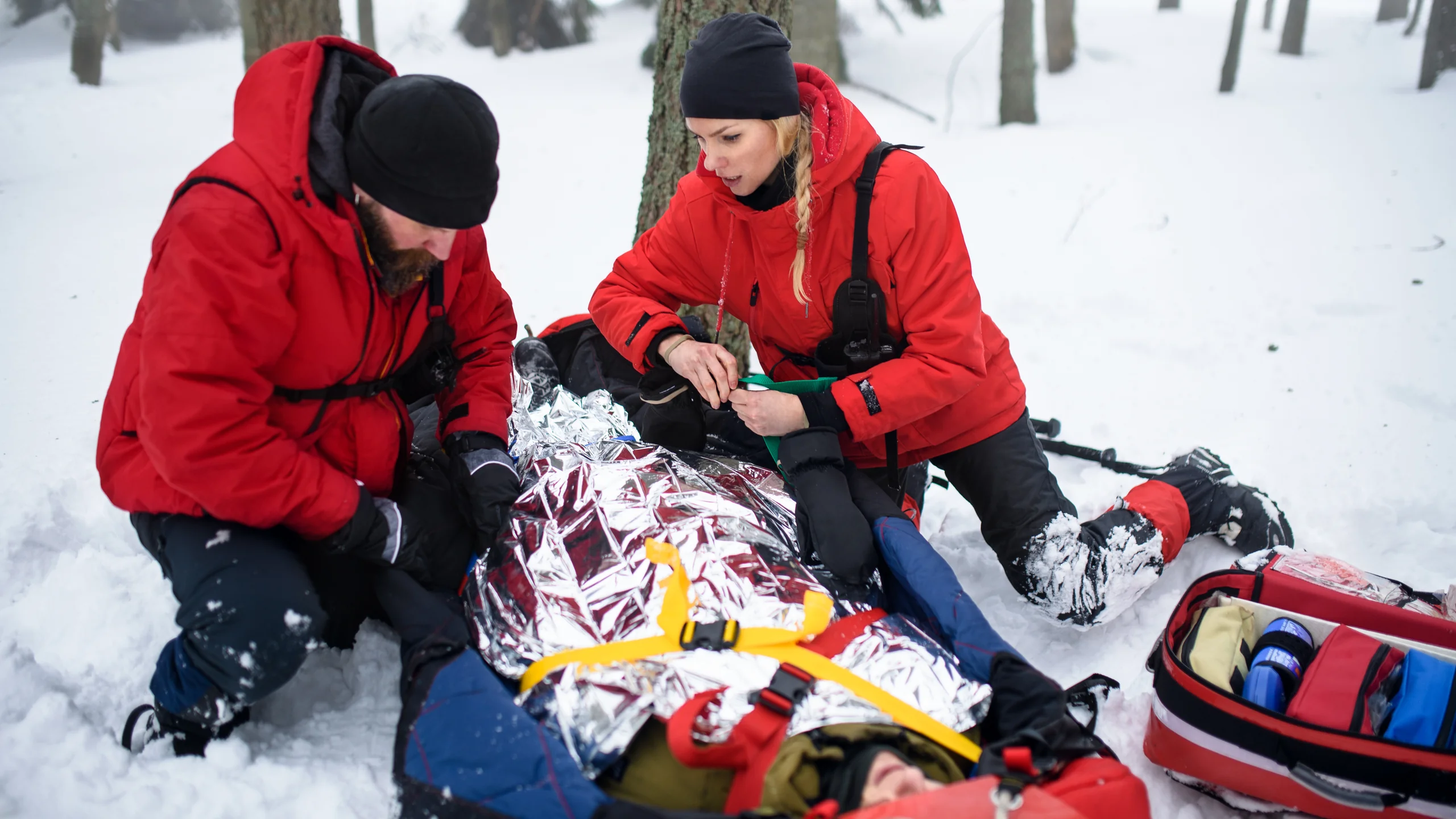
Fractures in the mountains are typical injuries after a fall — on descent, from climbing route, on ski pass, in avalanche. Most are closed limb fractures (arm, leg, clavicle), but there are also open (fracture + skin wound), spinal (dangerous!) and pelvic (death risk). Key skills: improvised immobilization (no one carries SAM splints), pulse assessment below fracture, evacuation decision. This article: recognition, immobilization protocol, when heli, when walk-out.
In a nutshell — fractures in the mountains
- Recognition: pain, swelling, deformity, crepitus, immobility, pain with loading
- P+S rule: Pulse and Sensory test — check pulse and sensation BELOW fracture before and AFTER immobilization
- Improvised splints: trekking poles, sleeping pad, backpack, branches; always immobilize 2 adjacent joints
- Walk-out evacuation: arm/clavicle fractures often YES, weight-bearing leg fractures often NO
- Heli evacuation: open fracture, spine, pelvis, weight-bearing leg, multiple fractures
- Medications: paracetamol + ibuprofen + tramadol (field analgesic ladder top)
Recognizing fractures in the field
Signs of probable fracture
- Sharp, severe pain worsening with movement/loading attempts
- Rapidly increasing swelling (minutes-hours)
- Deformity (non-physiological angle, limb shortening)
- Crepitus — audible/palpable bone fragment movement
- Unable to load or move the joint
- Ecchymoses (bruises) developing over hours
- No pulse below injury site or pallor/cyanosis of fingers
What can mimic a fracture
- Severe contusion — swelling, bruise, but no crepitus/deformity
- Sprained joint (ankle) — limited but preserved motion
- Muscle contusion — local tenderness but loading possible
- Tendon/ligament rupture — joint instability but no crepitus
Rule: when in doubt — treat as fracture. Immobilize, assess, evacuate.
Improvised immobilization — principles
General principles
- Check P+S BEFORE and AFTER immobilization (pulse, sensation, color)
- Immobilize 2 adjacent joints around fracture (e.g. forearm fracture → immobilize wrist and elbow)
- DO NOT reduce fracture in field — exception: no pulse (acute ischemia) or severe deformity preventing immobilization; even then VERY carefully
- Soft padding (clothing, moss) between splint and skin — prevents pressure sores
- Not too tight bandage — check finger pulse every 10 min
- Elevate limb to reduce swelling
Specific techniques
Forearm fracture
- Splint: 2 trekking poles on both sides, tied with pack straps or scarf
- Alternative: sleeping pad rolled into “trough” around arm
- Triangular scarf or buff — sling arm around neck to offload
Lower leg fracture
- Splint: 2 poles + sleeping pad — wrap around leg, tie with straps
- Alternative: use other leg as splint (immobilize BOTH legs together)
- Ice/snow pack for swelling first 2 h
- DO NOT load — any walking attempt worsens
Clavicle fracture
- Triangular sling — arm in flexed position
- Bandage to chest (Desault) to limit movement
- Patient can usually walk under own power — clavicle fracture doesn’t require heli
Suspected spine fracture
- DO NOT move patient from position where found (unless immediate life threat, e.g. avalanche)
- Manually stabilize head — kneel over patient, hold head with both hands in spinal alignment
- Don’t let him move — even asking “I’ll just stand up” — spinal cord damage is IRREVERSIBLE
- Heli evacuation IMMEDIATELY with spinal boards (TOPR has them)
- Red flags: limb numbness/weakness, sharp radiating pain, loss of sphincter control
Pain medications — field analgesic ladder
- Step 1: paracetamol 500–1000 mg every 4 h (max 60 mg/kg/day)
- Step 2: ibuprofen 400 mg every 6 h + paracetamol (synergy, better than either alone)
- Step 3 (field top): tramadol 50–100 mg every 6 h — OTC on foreign expeditions, prescription-only at home
- Morphine/fentanyl — only with medical team (TOPR)
- Avoid: alcohol (worsens bleeding), aspirin (like ibuprofen but weaker, less tolerated)
Decision: walk, stretcher, heli
Walk-out evacuation (self or with help)
- Clavicle, rib, arm (forearm) fracture — patient walks
- Stable general condition, good pain control
- Short distance to shelter/treatment (≤4 h marching)
Stretcher/ground rescue evacuation
- Leg fracture, complex arm fracture
- Weather prevents heli
- Distance 4–12 h with rescue team
Heli evacuation (priority)
- Open fracture (protruding bone, skin wound) — infection risk
- Spine fracture or suspicion
- Pelvic fracture (internal bleeding risk)
- Weight-bearing leg fracture (thigh/lower leg) with inability to march
- Multiple fractures (2+ bones)
- No pulse below fracture = acute ischemia
- Long distance (≥6 h foot) or difficult terrain
Frequently asked questions
Can I lay a patient with suspected spinal injury on their back?
ONLY if you found them already in that position and it’s stable. If you found them on side, face down or in strange position – DO NOT MOVE. Protocol: 1) Kneel at patient’s head, take head with both hands, stabilize in same position you found – DO NOT STRAIGHTEN. 2) Calm patient – ‘don’t move’. 3) Someone removes their helmet if worn (2-person procedure!). 4) Call for heli. 5) If you MUST move (oncoming avalanche, fire), use ‘log-roll’ with 4 people – one stabilizes head, others evenly rotate body as one log. Spine fracture suspicion exists with: fall >3 m, high-force injury (avalanche), limb pain/numbness, sensation loss below injury level.
Can I reduce a fracture in the field?
Basically NO. Reduction attempts without anatomical knowledge and experience can: 1) damage vessels (acute ischemia); 2) damage nerves (permanent weakness); 3) convert closed to open fracture; 4) worsen pain and shock risk. Exception: acute ischemia (fingers white, no pulse). Then mild ‘long-axis’ traction (pull limb along axis) until pulse returns – minimal movement, immobilize immediately. Second situation: fracture with such severe deformity that splint can’t be applied. Then one gentle manipulation to set axis, then immobilize. Each manipulation: short, one move, one time. Better poorly-immobilized fracture than permanently damaged limb.
How many trekking poles do I need for a splint?
Minimum 2 per limb fracture. For knee/thigh fracture minimum 3 (both sides and front), ideally 4. That’s why mountain teams carry 2 pairs of poles per person or spares. Alternative when no poles: backpack frame board, stiff branches (freshly broken, not dry brittle), rolled sleeping pad (used as ‘trough’ around limb). For clavicle no splint needed – triangular sling enough. Key rule: splint must span 2 joints adjacent to fracture.
Open fracture – what to do in field?
Protocol: 1) DO NOT touch protruding bone (even with gloved finger – deep infection risk). 2) Cover wound with STERILE dressing (not dusty gauze – use clean gauze from kit). 3) Immobilize limb as for closed fracture, but don’t push bone back. 4) Check P+S (pulse, sensation, color) every 15 min. 5) Antibiotic: if you have ciprofloxacin 500 mg or amoxicillin-clavulanate – start treatment. 6) HELI EVACUATION PRIORITY – infection risk <6 h, necrosis in 24 h. 7) Hospital will do debridement (surgical cleaning), external fixation, often multiple surgeries. Open fracture outcomes depend mainly on time to evacuation and antibiotic administration.
Tramadol in expedition kit – yes or no?
Yes, if you have prescription (Poland prescription-only, many expeditions OTC). Tramadol 50-100 mg every 6 h is ‘ladder top’ available to patient without medical staff. Pros: stronger than paracetamol+ibuprofen (especially for fractures), safe (doesn’t significantly affect breathing at proper doses), rapid absorption. Cons: sedation (don’t drive after tramadol), nausea in 20% patients (bring metoclopramide), seizure risk with overdose. For Everest BC expedition: 10 tablets 100 mg in team kit, used only for fractures/severe pain. DON’T use prophylactically ‘to sleep better’ – wrong medication for that.
References
- Ellerton JA, Greene M, Paal P. The use of analgesia in mountain rescue casualties with moderate or severe pain. Emerg Med J. 2013;30(6):501–505.
- Auerbach’s Wilderness Medicine, 7th ed. (2017) — Chapter 17: Field orthopedics.
- ICAR MedCom — Prehospital treatment of fractures in mountain rescue (2021).
Note: Fracture immobilization and assessment in mountains requires wilderness first aid course (WFR, Wilderness First Responder). This article is informational. Emergency numbers: 112, TOPR +48 601 100 300.