


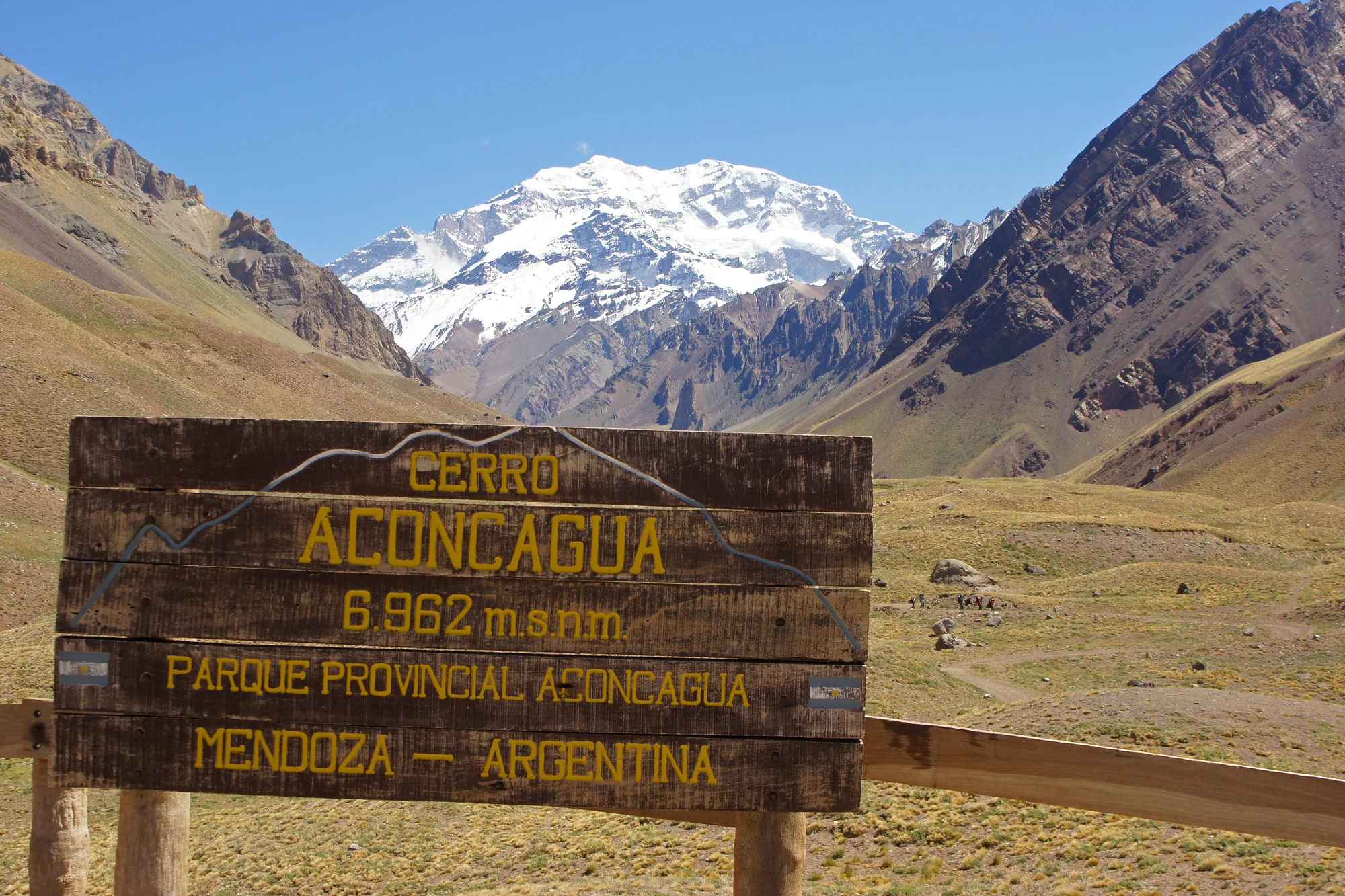
Aconcagua (6961 m) is the highest peak in both Americas and the highest outside Asia. Formally non-technical (the Normal Route requires only good fitness), medically it ranks among the most demanding 6000-meter peaks in the world. It combines extreme altitude, subtropical South American low atmospheric pressure, brutal viento blanco winds, and dry climate where dehydration develops twice as fast as in the Himalayas. In this brief: essential medical knowledge, non-negotiable drugs, and why the real summit success rate is 30–40%, not the 60% often advertised.
Aconcagua by the numbers
- Altitude: 6961 m
- Location: Mendoza, Argentina; 32° S latitude
- Typical expedition length: 16–21 days
- Summit success rate: 30–40% (Plaza de Mulas rescue station; some sources cite up to 60% but only for professional expeditions)
- Historical mortality: 0.5–1% of attempts, mainly HAPE, HACE, hypothermia, exhaustion
- Summit temperature: typically −20 to −30°C, with wind chill <−50°C
Why Aconcagua is medically harder than altitude suggests
The latitude effect
Aconcagua lies at 32° S — far from the equator. Atmospheric pressure at a given altitude is 5–10% lower than on Everest (which sits near the equator). The “felt altitude” of Aconcagua is oxygen-availability-wise equivalent to 7200–7400 m in the Himalayas. Hence the nickname “a seven-thousander in disguise”.
Dry climate and dehydration
The Argentine Andes is one of the driest high-altitude regions — humidity above 4000 m is often 10–20%. The body loses 6–8 L water daily through lungs and skin (vs 3–4 L in the Himalayas). Dehydration develops imperceptibly and worsens altitude tolerance. Target: 4–6 L hydration/day with electrolytes.
Viento blanco — the killing wind
Viento blanco is a hurricane-force wind (70–150 km/h) that hits without warning above 5500 m. Drops felt temperature tens of degrees, causes instant facial frostbite, drastically increases heat loss. A summit push in viento blanco is medically impossible — immediate abort and tent descent required.
UV and dry atmosphere
UV index on Aconcagua regularly exceeds 11–14 (scale maximum). Snow and ice reflection adds 80% exposure. Consequences: sunburn in minutes, snow blindness (actinic keratitis of cornea), lip and face irritation. Mandatory: glacier glasses with side shields, SPF 50+ reapplied every 2 h, lip balm with filter, buff.
Most common medical problems on Aconcagua
AMS, HAPE, HACE
Due to the latitude effect, HAPE and HACE are more common on Aconcagua than in the Himalayas at equivalent altitude. At Plaza de Mulas (4300 m) cases already appear — often after too-fast ascent from Mendoza (760 m) in 2 days. Acetazolamide prophylaxis 125 mg twice daily starting 24 h before reaching 4300 m is broadly recommended. Details: Altitude sickness — complete guide.
Hypothermia and frostbite
Summit push takes 10–14 hours at −20 to −30°C. Plaza de Mulas base doctor statistics: each season several cases of III–IV degree frostbite (fingers, toes, nose, ears), occasional amputations. HT I–II hypothermia occurs in 10–15% of summit attempts, mainly after glove loss or fatigue-induced pace decline.
Exhaustion and psychological breakdown
Uncommonly frequent compared to other 6000-ers. Combination of extreme altitude, dry winter, multi-day bivouac in isolation, and Normal Route monotony gives a high rate of “unfinished” expeditions. Aconcagua is known for its psychological dimension: physically most trekkers manage, mentally they break.
Traveler’s diarrhea
Water on Aconcagua comes from melted snow and glaciers — theoretically clean, but contamination from mules or upper camps is real. In Mendoza before departure — classic traveler’s diarrhea. Classification and treatment: Traveler’s diarrhea on expedition.
Aconcagua-specific medical kit
- Acetazolamide — 40 tablets (prophylaxis + 3 weeks of treatment)
- Dexamethasone — tablets + injection (HACE rescue)
- Nifedipine 20 mg retard — 10 tablets (HAPE rescue)
- Ibuprofen 400 mg — 40 tablets
- Vitamin A or panthenol ointment — for nose and lips (cracks from dry air)
- SPF 50+ cream — waterproof, minimum 200 mL per person
- SPF 30+ lip balm — 2 units
- Chemical warmers — 20 per person (summit push + reserve)
- ORS/electrolytes — 30 sachets (dry climate!)
- Azithromycin 500 mg — 6 tablets (traveler’s diarrhea)
- Loperamide — 20 tablets
- Hyaluronate eye ointment — 1 unit (snow blindness + dry air)
Typical expedition acclimatization profile
- Day 1–2: Mendoza (760 m) — organizer meeting, permit registration, final shopping
- Day 3–5: Hike to Plaza de Mulas (4300 m) or Plaza Argentina (4200 m)
- Day 6–8: Acclimatization rotation to Camp Canadá (5050 m), back to base overnight
- Day 9–11: Rotation to Camp Nido de Cóndores (5550 m), 1 night, back
- Day 12–14: Rotation to Camp Berlín / Camp Cólera (5900–6000 m), summit prep
- Day 15: Summit push from Cólera (10–14 h), descent to tent
- Day 16–18: Descent to base and Mendoza
- Reserve 2–3 days for weather window and unforeseen events
When to abort the summit push
- Viento blanco or forecast >70 km/h winds
- SpO₂ below 70% at rest at Cólera (6000 m)
- Headache unresponsive to paracetamol/ibuprofen at HT I or worse
- Superficial finger frostbite before summit — risk of deepening
- Persistent dehydration despite 6 L/day ORS
- Any HAPE symptoms (dyspnea at rest, cough with foamy sputum)
Aconcagua belongs to technically “forgiving” mountains, but medically unforgiving. The decision to turn back from 6300 m (Portezuelo) in bad weather is more common than you’d expect — and sensible. Aconcagua can be revisited: season runs from mid-November to mid-March, weather windows open several times per season.
Frequently asked questions
What is the real Aconcagua summit success rate?
Parque Provincial Aconcagua statistics from last 10 years: ~30–40% of attempts succeed. Higher figures (50–60%) cited by some expedition companies refer to professional expeditions with full support and experienced clients. Main failure causes: altitude sickness, poor weather window (viento blanco), physical and psychological exhaustion.
Is Diamox necessary on Aconcagua?
Not mandatory but strongly recommended for most participants. Due to the latitude effect (lower atmospheric pressure than Everest at equivalent altitude) and typically fast ascent profile (Mendoza 760 m → Plaza de Mulas 4300 m in 3 days), prophylaxis 125 mg twice daily starting 24 h before 4000 m significantly lowers AMS frequency.
How much water on Aconcagua?
4–6 L/day with electrolytes. Twice the Himalayan requirement due to extremely dry climate (10–20% humidity). On summit day target is 3–4 L over 10–14 h of climbing, requiring hot thermoses (water freezes in bottles at -25°C).
Is Aconcagua harder than Everest Base Camp trek?
Medically yes, significantly. EBC trek ends at 5364 m with lodge accommodation with heating and food. Aconcagua requires self-pitching tents to 6000 m, self-cooking in extreme cold, sleeping at 5900 m before summit. Plus summit at 6961 m vs roughly 5600 m Kala Patthar on EBC. Both technically non-technical — but Aconcagua demands much more fitness, medical, and logistical readiness.
When is Aconcagua climbing season?
Official Parque Provincial Aconcagua season: mid-November to mid-March (Southern Hemisphere summer). Best weather windows usually January and February. Off-season winter attempts (June–August) technically possible for very experienced climbers but require full expedition gear and are significantly more risky.
References
- Parque Provincial Aconcagua — official seasonal statistics.
- West JB. High Life: A History of High-Altitude Physiology and Medicine. Oxford University Press, 1998.
- Ward, Milledge & West’s High Altitude Medicine and Physiology, 6th ed. CRC Press, 2021.
Disclaimer: This article is informational and does not replace consultation with an expedition medicine physician. Every Aconcagua expedition requires an individual medical plan. Emergency in the region: Parque Provincial Aconcagua rescue +54 261 425-2090.