


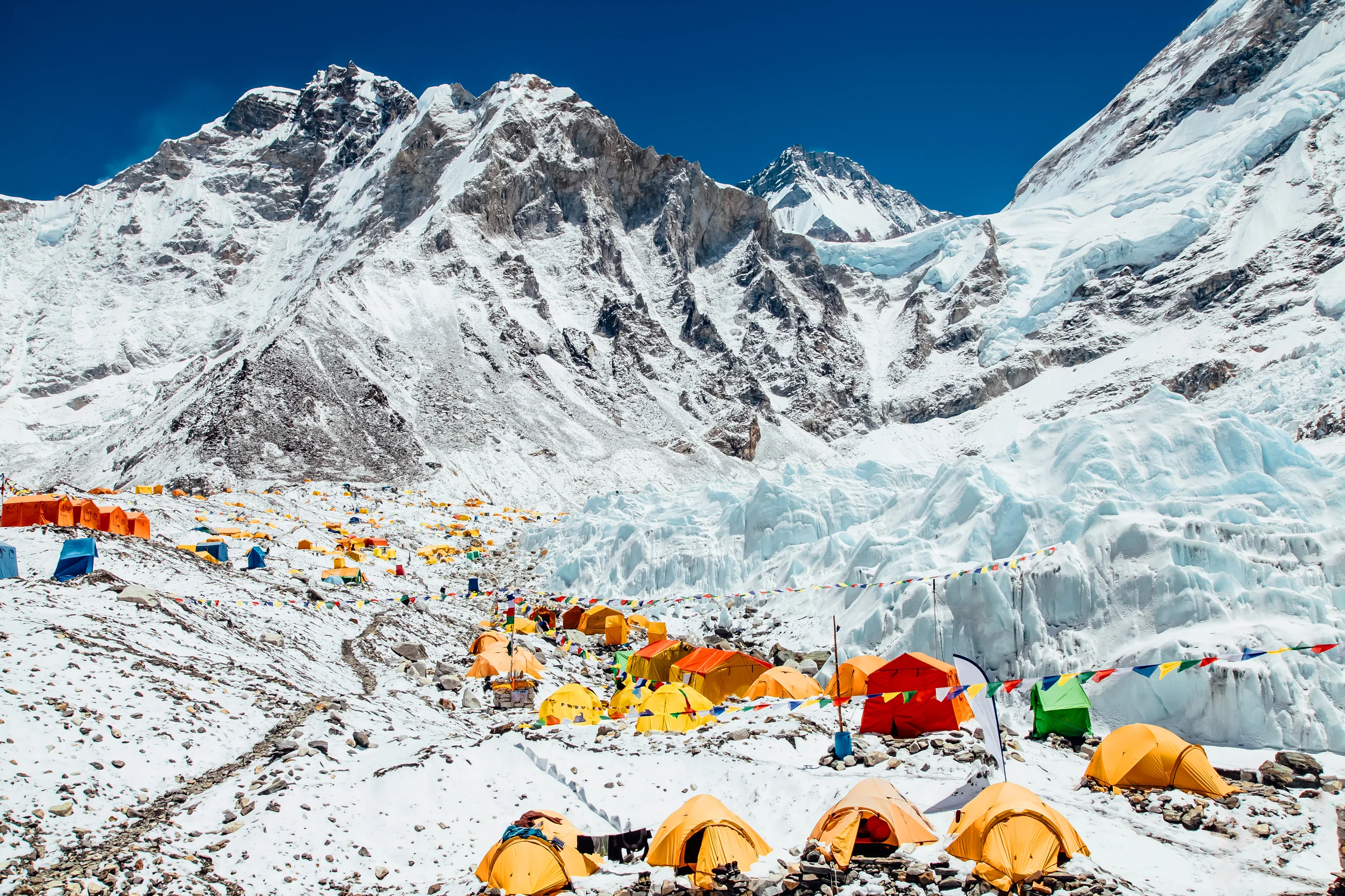
Everest Base Camp (5364 m) is the world’s most famous trekking destination and simultaneously a place where significant medical problems appear in a meaningful fraction of participants. Nepal’s Khumbu valley opens to trekkers in two seasons yearly (pre-monsoon March–May and post-monsoon September–November) and hosts tens of thousands of visitors annually. The trek is physically moderately demanding but medically requires solid preparation — that small altitude shift between Dingboche (4400 m) and Lobuche (4940 m) is a real moment when many people start to struggle. This brief: what you need to know before flying to Lukla.
EBC trek in numbers
- Destination: Everest Base Camp 5364 m
- Typical duration: 12–14 days (Lukla → EBC → Lukla)
- Starting point: Lukla 2860 m (flight from Kathmandu)
- Key overnight stops: Namche Bazaar 3440 m, Dingboche 4400 m, Lobuche 4940 m, Gorak Shep 5164 m
- Percent trekkers with AMS: 30–50%, frequency rises from Dingboche upward
- Helicopter evacuations per season: approximately 400–600 (Himalayan Rescue Association)
The Lukla flight — first trap
The Kathmandu to Lukla flight is considered one of the most dangerous commercial flights in the world. The airport has a very short uphill runway, and takeoff is almost into a gorge between mountains. All landing risk factors are minimized — mainly weather. One waits for a weather window; often 1–3 days.
Practical: do not plan the trek so the Lukla flight day is the last reserve day. If weather fails, waiting several days is normal. Helicopters are an alternative (faster, fly in worse weather) but significantly more expensive.
Standard 12-day acclimatization profile
- Day 1: Flight Kathmandu → Lukla (2860 m), trek to Phakding (2610 m) — sleep lower than start!
- Day 2: Phakding → Namche Bazaar (3440 m)
- Day 3: Namche — acclimatization day (short walk to Everest View Hotel 3880 m, night back in Namche)
- Day 4: Namche → Tengboche (3860 m)
- Day 5: Tengboche → Dingboche (4410 m)
- Day 6: Dingboche — acclimatization day (Nangkartshang 5083 m, overnight in Dingboche)
- Day 7: Dingboche → Lobuche (4940 m) — critical day
- Day 8: Lobuche → Gorak Shep (5164 m) → Everest Base Camp 5364 m → overnight in Gorak Shep
- Day 9: Gorak Shep → Kala Patthar (5643 m) at sunrise → descent to Pheriche (4240 m)
- Day 10–12: Descent to Lukla
- Day 13: Flight Lukla → Kathmandu
This plan maintains the 300–500 m/day rule from Namche. Two acclimatization days (Namche and Dingboche) are essential — shortening the trek to 8–10 days (as some operators do) drastically increases AMS rates.
Where medical problems appear — observations from practice
Dingboche 4400 m — first line
During expedition medical care in the Everest region the first serious altitude problems are observed in Dingboche for some climbers. Typical picture: headache on day two at 4400 m, loss of appetite, reluctance to leave the lodge. A dose of ibuprofen 400 mg + 2 L water with electrolytes + a rest day usually resolves the problem. For some — full-blown AMS requiring loperamide, acetazolamide, and observation.
Lobuche 4940 m — HAPE/HACE boundary
From observations near EBC, the threshold beyond which it gets truly critical in terms of acute symptoms is around 5000 m. Above this altitude finding a participant without any complaints becomes difficult. An overnight in Lobuche is the moment when first severe AMS or developing HAPE cases appear (dyspnea at rest, cough).
Everest Base Camp 5364 m — symptom plateau
Trekkers reaching EBC and returning the same day to Gorak Shep usually avoid serious incidents. Those who overnight in Gorak Shep (5164 m) often have restless nights — Cheyne-Stokes breathing, insomnia, headache. Kala Patthar (5643 m) at sunrise is a physiological challenge for most people — a short climb with panoramic views of Everest bought at the price of an hour’s “loan” from reserves.
HAPE and HACE on EBC trek — cases from practice
From two months of work at Everest Base Camp in the 2022 season — two classic medical cases worth knowing for anyone going on the trek:
Case 1: HACE at night, lodge between Lobuche and EBC
A man from another team complained of weakness in the evening and had diarrhea. The team assumed food poisoning. In the middle of the night I heard someone collapse in the corridor. Diarrhea had been joined by vomiting, slurred speech, agitation, and balance disturbances — classic ataxia. SpO₂ was just 50%. Diagnosis: high-altitude cerebral edema, the fastest killer in high mountains. Oxygen + dexamethasone + helicopter evacuation at 6 AM. The patient survived because we acted in hours, not days.
Case 2: HAPE on the final stretch before EBC
A teammate on the final stretch before Everest Base Camp started breathing “strangely”. Initially it didn’t worry us — climbers panting at altitude is normal. The problem was that he was dyspneic at rest — standing or sitting. That’s the alarm for HAPE. We reached the camp and immediately organized helicopter evacuation. The teammate had no doubts the expedition was over for him.
“Khumbu cough” — lesson from the Sherpas
One of the most important things Sherpas teach and I teach others to this day — during trekking it is worth fully covering nose and mouth with a buff-type scarf to avoid developing the dry cough from dust and cold dry air. This extremely exhausting, characteristic “Khumbu cough” is a real epidemic in the Himalayas. The Sherpa method works 100% — a cough that lingers for months in many trekkers after return can be completely prevented.
During the two-month base camp stay I also saw a minor rib fracture from intense dry coughing — a measure of how exhausting “Khumbu cough” can be for a trekker who ignored the buff. The rib fracture isn’t medically dangerous, but during summit push or descent it is significantly limiting.
EBC-specific medical kit
- Pulse oximeter + batteries + laminated Lake Louise Score
- Acetazolamide 250 mg — 20 tablets
- Dexamethasone — tablets + injection ampoule (HACE rescue)
- Nifedipine 20 mg retard — 6 tablets (HAPE rescue)
- Paracetamol / ibuprofen — 30 tablets each
- Azithromycin 500 mg — 3–6 tablets
- Loperamide — 20 tablets
- Metronidazole 500 mg — 15 tablets
- ORS/electrolytes — 20 sachets
- Buff scarves — 2 units (Khumbu cough prevention!)
- Cough tablets/syrup
- Nose ointment with vitamin A or panthenol, moisturizing spray
- Eye ointment/drops with hyaluronate
- Glacier glasses with side shields
- SPF 50+, lip balm with filter
Medical help in Khumbu valley
Himalayan Rescue Association (HRA)
HRA runs three medical posts along the trail: Pheriche (4240 m), Manang (Annapurna), and Everest Base Camp (seasonally). At EBC in season typically 3 doctors on duty. Worth knowing that realistically they cannot monitor all participants present — at peak season that’s 500–1000+ people in base. Every afternoon HRA gives free medical lectures for trekkers (AMS, acclimatization, gear). Worth attending.
Helicopter evacuation
Several rescue helicopter operators work the valley (Simrik Air, Air Dynasty). Evacuation cost: 3000–5000 USD (covered by trekking insurance if you have it). Response time in good weather: 1–3 h. At night and in bad weather they don’t fly — plan medically with this uncertainty in mind.
When to abandon the goal (EBC)
- Any HAPE sign (dyspnea at rest, cough with foamy/pink sputum) → immediate descent
- Any HACE sign (ataxia, confusion, severe unresponsive headache) → oxygen + dexamethasone + evacuation
- SpO₂ <70% in Lobuche at rest after 30 min of rest
- Prolonged diarrhea with dehydration unresponsive to ORS
- Grade I finger frostbite before EBC — deepening risk with continued march
EBC won’t run away. Neither will sea level. Your health very well can, if forced at 5000+ m. Return is not defeat — it’s treatment. Rule in mountain medicine: better to descend a day early than an hour late.
Frequently asked questions
Is EBC trek safe for 40+ without high-altitude experience?
Yes, if: normal aerobic tolerance (6 h walking daily with 8 kg pack), no cardiac/pulmonary disease, 12-14 day plan with two acclimatization days, and AMS awareness. Statistically most successful EBC trekkers are 35-55 years old. Pre-expedition consultation with a travel medicine physician recommended.
Is Diamox needed prophylactically on EBC trek?
Not for most at standard 12-14 day plan. If plan is shorter (8-10 days, fast ascent) — yes. If you have AMS/HAPE/HACE history — yes, 125 mg twice daily from 24 h before 3500 m. Otherwise reserve acetazolamide for treating symptoms if they arise. In my opinion the best acclimatization is natural, without prophylactic medication.
What to do when a group member acts strangely at night?
Assess: can they walk a straight line? Stand stable with eyes closed? Touch finger to nose? Answer logically? If any of these is impaired + low saturation (<75%) + headache — assume HACE. Management: oxygen (if available), dexamethasone 8 mg oral or IM, call for help, prepare evacuation. Don't wait until morning — HACE can kill in hours.
How much does trekking insurance with helicopter evacuation cost?
Good policies covering helicopter evacuation to 6000 m cost 80-250 EUR for 2-3 weeks. Check limits: minimum 15000 EUR for evacuation (actual cost 3000-5000 USD, plus Kathmandu hospitalization). Recommended: World Nomads, Global Rescue. Read conditions — some policies exclude above 4500 m.
When is the best time for EBC trek?
Two seasons: pre-monsoon (late March-May) and post-monsoon (late September-November). May is warmest and busiest (Everest climbing season). October usually has cleanest sky and best views but can be colder. Monsoon (June-September) closes the trail. Winter (December-February) technically possible but -25°C in Gorak Shep and few lodges open.
References
- Himalayan Rescue Association — Pheriche Aid Post seasonal reports.
- Basnyat B, Murdoch DR. High-altitude illness. Lancet. 2003;361(9373):1967–1974.
- Luks AM, Auerbach PS, Freer L, et al. Wilderness Medical Society Clinical Practice Guidelines: 2019 Update. Wilderness Environ Med. 2019;30(4S):S3–S18.
Disclaimer: This article is informational and does not replace consultation with an expedition or travel medicine physician. In Nepal emergencies: Himalayan Rescue Association (+977-1-4427044), tourist police 1144.