

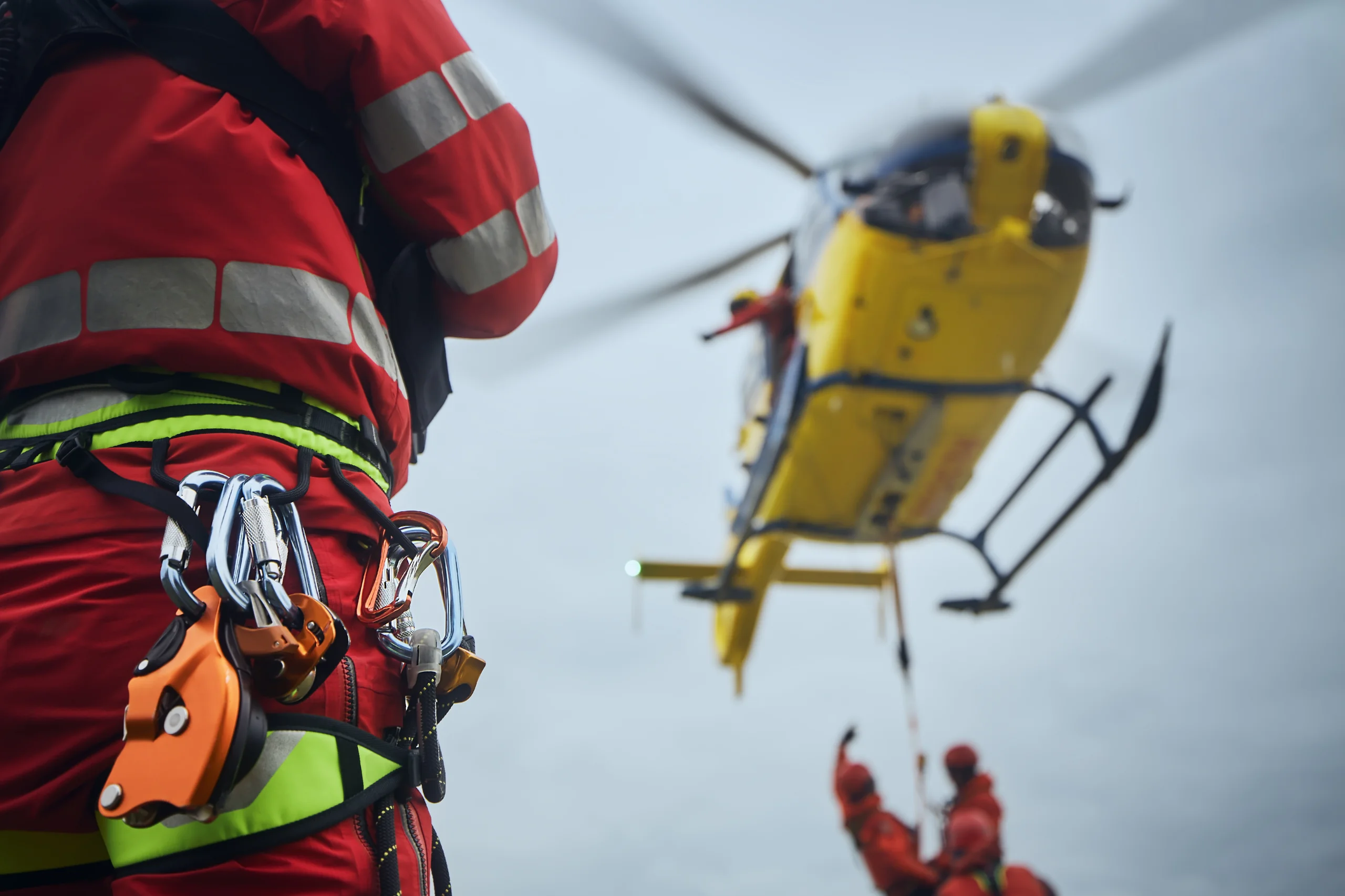
Helicopter evacuation in the Polish mountains is the specialty of TOPR (Tatra) and GOPR (other ranges). In 2024 TOPR conducted >400 rescue operations, ~120 using helicopter. Helicopter is the fastest casualty transport method, but has hard limits: weather, visibility, ceiling, wind. This article: how to call for help, what to do before arrival, costs (no, it’s not free — insurance matters), HEMS vs SAR limitations.
In a nutshell — helicopter evacuation
- TOPR number: +48 601 100 300 (24/7) or 985 (GOPR); European: 112
- Ratunek app (free, PL iOS/Android) — sends GPS + medical data to TOPR/GOPR dispatcher
- TOPR helicopter: Sokół W-3A (ceiling 5500 m, max wind 60 km/h, clouds → WON’T fly)
- Limitations: dusk (some operations), clouds/fog, wind >60 km/h, storms
- Cost: TOPR rescue in Poland FREE (state-funded); abroad $5000–15000/h
- LZ (landing zone): ideally 30×30 m flat, no power lines, wind <30 km/h
How to call TOPR/GOPR — protocol
Step 1 — decide you need help
Don’t hesitate. TOPR prefers 10 false alarms over 1 unsent call — better to phone when uncertain than wait for deterioration. Typical indications: HAPE/HACE, heat stroke, fracture preventing descent, major bleeding, unconsciousness, avalanche burial, fall from height.
Step 2 — call dispatcher
TOPR: +48 601 100 300 (Tatras), GOPR: 985 (other Polish mountains), 112 (universal). The dispatcher call includes:
- Who’s calling (name, phone number)
- Where you are — GPS coordinates (Ratunek app) or location name + altitude
- How many casualties
- What happened (mechanism of injury, symptoms)
- Casualty status (conscious, breathing, bleeding, temperature)
- Local weather (clouds, visibility, wind) — key for helicopter decision
- Don’t hang up until dispatcher says “you can end the call”
Step 3 — prepare site and casualty
- LZ (Landing Zone): flat 30×30 m area, no rocks, wires, trees within 50 m radius
- Mark LZ: cross made of backpacks/poles, flag, flare if you have one
- Wind direction: stand in front of helicopter with back to wind, show wind direction with fingers
- Secure casualty: keep warm, recovery position, dressings if bleeding
- Move loose gear 50+ m from LZ — rotor generates 80+ km/h wind, gear flies like projectiles
- DON’T approach the helicopter without pilot signal — especially from behind (tail rotor!)
During rotations and the summit push my only contact with the team was by radio, and that is the hardest form of medicine I know: it is difficult to diagnose anything at a distance, with no way to examine the patient. That is why precision matters when you call for help — specific symptoms, the altitude and how long they have lasted say more than any judgement of how bad it looks.
Weather limitations — when helicopter WON’T fly
- Low clouds (base <300 m above ground) — VFR impossible
- Visibility <1500 m — visual flight impossible
- Wind >60 km/h sustained or gusts >80 km/h — crew safety risk
- Storm in region (lightning, hail) — absolute no
- Dusk — some crews fly at night (NVG), but many flights are declined
- Icing — dangerous when immersed in cloud
Plan B: if helicopter can’t fly — TOPR dispatches ground team (rescuers on foot, with stretchers or snowmobile). Time to reach in Tatras: 1–4 h depending on location. Keep dispatcher on the line, manage casualty as if alone.
HEMS vs SAR — the difference
- HEMS (Helicopter Emergency Medical Service): rapid transport with physician. Goal: pick up and fly to hospital. Mission max 30 min on scene.
- SAR (Search and Rescue): search and rescue operation. Can last hours, higher-equipped team (winch, climbing rescuers), access into difficult terrain (wall, glacier crevasse).
In Poland TOPR/GOPR combine both functions in one team. Abroad (Alps, Nepal) HEMS and SAR may be separate — relevant for insurance.
Costs — don’t be surprised
Poland
TOPR/GOPR rescue operations in Poland are FREE for the casualty — state-funded. Unique in Europe. But warning: evacuation from Poland to another country (e.g. helicopter from Slovak Tatras to Kraków hospital) may generate costs at the border.
Abroad
- French Alps (Chamonix MRT): hour of helicopter operation €5000–10000
- Swiss Alps (Rega): €3000–8000; Rega membership CHF 40/year = no cost in Switzerland
- Nepal: $5000–15000 for heli from EBC; must be embassy-authorized and paid upfront or via insurance
- Tanzania Kilimanjaro: helicopter rarely available, evacuation foot + ATV $2000–5000
Helirescue insurance
- Polish mountain insurance (PZU, Signal Iduna, ERGO): $30–80 for 2 weeks, heli coverage up to €50000
- Global Rescue: $150–600/year, covers evacuation worldwide including Himalayas
- Rega (Switzerland): CHF 40/year — for Alps enthusiasts, best price/quality
- AAC (American Alpine Club): $85/year + $5000 evacuation coverage
- Warning: check definition of “climbing” and “high altitude” — many policies exclude >4500 m, via ferrata, ski mountaineering
Ratunek app — mandatory
- Free on iOS and Android — search “Ratunek”
- What it does: sends SMS to TOPR/GOPR dispatcher with your GPS coordinates + preliminary medical data
- Setup: enter contact data (name, ID number), chronic conditions, medications, allergies
- Works on low signal — single SMS is enough, doesn’t require LTE or voice call
- Offline — saves alerts when no signal, sends immediately upon coverage
- Install BEFORE leaving, not on location!
Frequently asked questions
Does a TOPR rescue cost me as the casualty?
No, in Poland TOPR and GOPR rescues are completely free for the casualty, regardless of whether you’re Polish, foreign, insured or not. State-funded (Mountain Safety Act 2011). Unique system in Europe. WARNING: this rule applies ONLY to Polish mountains. If the rescue was not fully on Polish side (e.g. you fell on Slovak side of Tatras), Slovak HZS service may issue a bill €500-3000. TOPR-friendly insurance covers all scenarios.
When will the TOPR helicopter definitely NOT arrive?
Three main limitations: 1) Weather – clouds <300 m above ground (VMC impossible), visibility 60 km/h or gusts >80 km/h, storm, icing. 2) Technical – Sokół W-3A malfunction, periodic maintenance. 3) Location – landing impossible (vertical wall, dense forest, no LZ). In these cases TOPR sends ground team (1-4 h in Tatras) – this doesn’t mean no rescue, just slower form.
How to properly indicate landing zone to the pilot?
Standard protocol: 1) Helicopter appears – STAY put, don’t run to it. 2) Stand SIDEWAYS to wind direction (pilot needs to know which way to approach). 3) Show wind direction with fingers (extend arm toward where it blows). 4) Cross made of backpacks or poles marks LZ. 5) When helicopter lands – MOVE BACK 50 m, turn away (from dust, flying debris). 6) Approach only WHEN TOPR rescuer waves to you, ALWAYS from the FRONT of helicopter (not from tail – tail rotor!).
Ratunek app – how it works without coverage?
The Ratunek app (TOPR/GOPR Association) works via SMS, doesn’t require LTE/WiFi. When you press ‘Call for help’, the app tries to send SMS to dispatcher. If no signal – the app saves the message and sends IMMEDIATELY upon catching any coverage. Important, because Tatras have no-signal locations (Pięciu Stawów, Morskie Oko in winter). Tip: move 50-200 m toward higher terrain – often enough to catch one bar. Secondary channel: satellite InReach or Spot ($15-40/month) guarantees coverage always.
Does Polish mountain insurance for $40 cover Elbrus?
No. Polish ‘mountain’ insurance (PZU, Signal Iduna, ERGO) covers mainly Poland + Alps + Himalayas up to certain altitude, but ceiling is usually 4500 m. Elbrus 5642 m is HIGHER. You need: 1) purchase ‘high altitude’ extension (+$25-80), OR 2) buy specialist policy: Global Rescue ($200-600/year), Garant24 High Altitude, Ultralife Alpinist. For Elbrus: Global Rescue or Garant24 +5500 m. Cost ~$200 per expedition. Absolutely before departure verify altitude clause, ice climbing, heli rescue.
References
- TOPR — official 2024 rescue statistics, topr.pl.
- Polish Mountain Safety Act (2011).
- Tomazin I, Vegnuti M, Ellerton J, et al. Medical standards for mountain rescue operations using helicopters. High Alt Med Biol. 2011;12(4):335–341.
- ICAR Medical Commission — Commission Internationale de Sauvetage Alpin, ikar-cisa.org.
Note: This article describes general principles — in a specific rescue situation always follow TOPR/GOPR dispatcher instructions. Numbers: TOPR +48 601 100 300, GOPR 985, universal 112.