


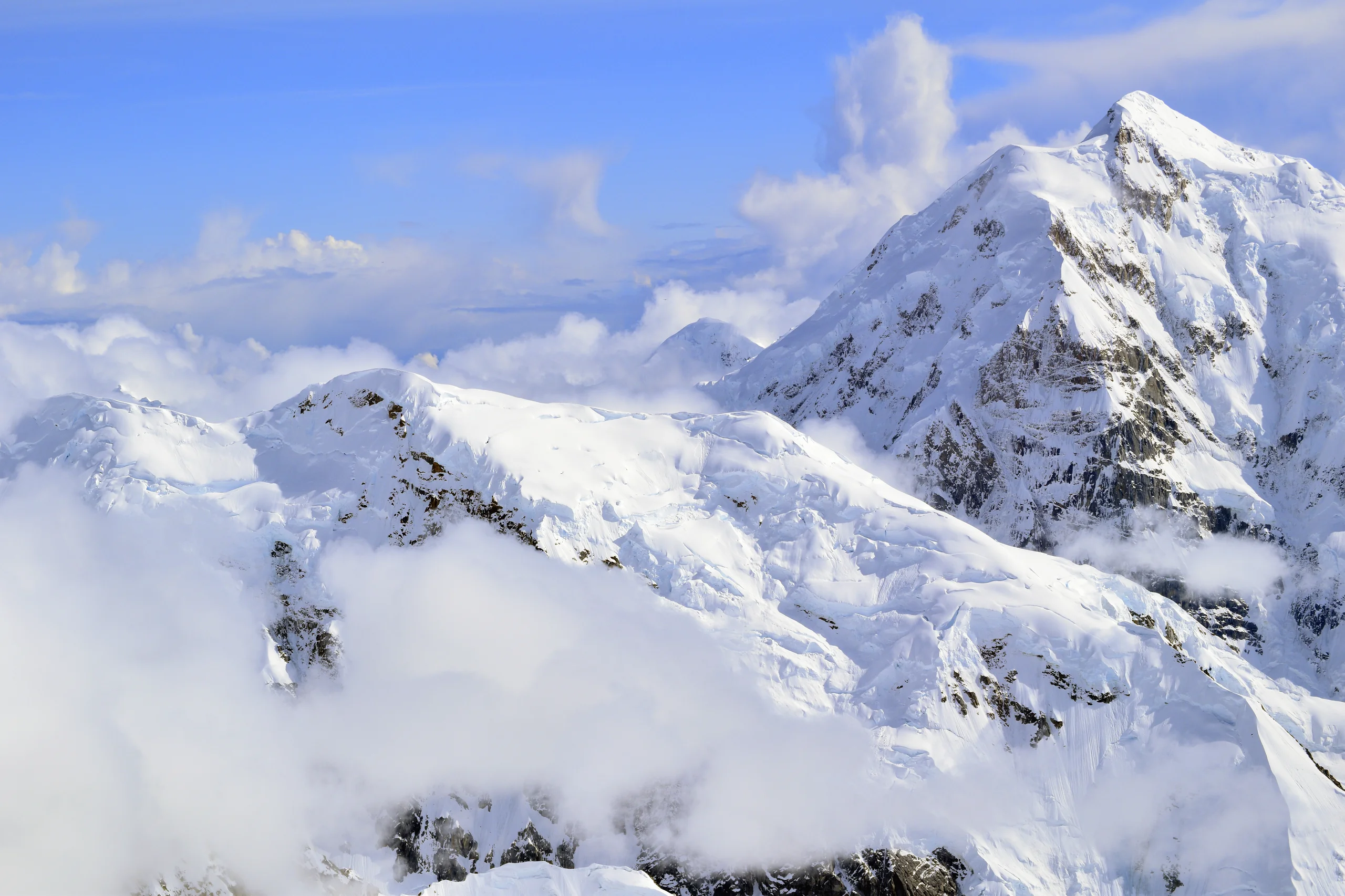
Denali (6190 m) — North America’s highest peak and one of the most extreme medical environments in the world. Formally “only” a 6000-er, physiologically it behaves like 7000–7500 m due to its location at 63° latitude. Arctic cold (−40°C is not rare), winds up to 150 km/h, total isolation — this is not Kilimanjaro. This brief: why Denali kills more climbers than Everest (proportionally), what you need to know about the latitude effect, and what medicine looks like at the NPS Mountaineering Ranger Station at 4300 m.
Denali by the numbers
- Altitude: 6190 m (South Summit)
- Location: Alaska Range, Denali National Park, USA; 63° N
- Typical length: 18–24 days (classic West Buttress Route)
- Summit success: 50–55%
- Historical mortality: ~100 deaths since 1913, 1–3 deaths/year
- Pressure equivalent altitude: ~7000–7500 m in Himalayas
- Coldest recorded: −59°C at 5200 m (High Camp)
- Summit wind: regularly 80–150 km/h, rarely >200 km/h
The latitude effect — why Denali “weighs” more
Atmospheric pressure at a given altitude depends on latitude. Closer to the equator — “thicker” atmosphere (more air above you). Closer to the poles — thinning is stronger at the same altitude.
For comparison: on the summit of Everest, at 28° north, pressure is 337 hPa. On Denali (63° N) at 6190 m it is about 360 hPa — roughly what you would meet at 6900 m near the equator. In winter, when system pressure drops further, the same summit delivers conditions equivalent to 7300–7500 m in the Himalaya.
I remember it in a simpler form: if Everest stood in Alaska, climbing it without supplementary oxygen would be impossible. The same number of metres at a different latitude is an entirely different physiology.
Practical implications: climbers after Aconcagua (6961 m, 32° S — similar effect to Denali) often feel “better” at Everest 5364 m Base Camp than at Denali High Camp 5200 m — despite Denali being theoretically 164 m lower. Oxygen tolerance is realistically lower.
Most important medical threats
Frostbite — dominant evacuation cause
NPS Mountaineering Ranger Station at 4300 m (so-called “14 Camp”) records 30–60 grade III/IV frostbite cases per year. Most common locations: fingers (working with ropes in mitten gloves), feet (boots too tight with thick socks), nose and ears (poor masks). −40°C + 80 km/h wind gives felt temperature <−60°C — 10 min exposure = grade II frostbite.
HAPE and HACE — more common than in Himalayas at same altitude
Due to latitude effect, HAPE on Denali occurs in 5–8% of climbers (twice as often as on Everest BC), HACE in 1–2%. The transition from 4300 m (14 Camp) to 5200 m (High Camp) — 900 m in one day — is particularly risky. Acetazolamide prophylaxis 125 mg twice daily standardly recommended from 3000 m.
Crush syndrome in avalanches
Denali has large glaciers (Kahiltna Glacier), where crevasses and seracs are real threats. NPS statistics: 2–4 avalanche incidents per year, with 30–40% involving severe trauma or crush syndrome. Mandatory ropes + avalanche beacon + probe + shovel on glacier.
Exhaustion + dehydration on long expedition
21-day expedition with self-carrying 40–60 kg gear (classically on sleds pulled by half the expedition to Camp 1). Energy deficit of 1500–2000 kcal/day is normal. Most climbers lose 5–8 kg body mass. Rhabdomyolysis risk in undernourished climbers at expedition’s end.
West Buttress — classic 21-day profile
- Day 1–2: Anchorage → Talkeetna → flight to Kahiltna Base (2200 m)
- Day 3: Base → Camp 1 (2400 m) — sled-hauling
- Day 4–5: → Camp 2 (3400 m) via Ski Hill
- Day 6–8: → Camp 3 (4300 m), so-called “14 Camp” (NPS Ranger Station)
- Day 9–11: acclimatization, rotation to 4800 m (Windy Corner), carry to 5200 m (High Camp)
- Day 12: Camp 3 → Camp 4 (5200 m) — 900 m in one day
- Day 13–15: weather window — summit push (5200 m → 6190 m → 5200 m, 12–16 h)
- Day 16–19: descent to Base Camp
- Day 20–21: flight to Talkeetna, reserve
Denali-specific medical kit
- Chemical warmers — 20–30 per person (key gear)
- Acetazolamide × 40 (3 weeks prophylaxis + reserve)
- Dexamethasone + ampoules (HACE rescue)
- Nifedipine retard 20 mg × 10 (HAPE rescue, higher frequency than Everest)
- Ibuprofen + paracetamol + metamizole
- Aspirin 300 mg × 30 (frostbite/thrombosis prophylaxis)
- Augmentin 875/125 mg × 20 (infected frostbite wounds)
- Insulated-housing pulse oximeter (standard ones fail <−20°C)
- Core thermometer (rectal) — for hypothermia assessment
- Frostbite kit: tPA (at NPS Station), sterile dressings, vitamin A ointment
- 1 L fully insulated thermos — water freezes in standard one in 30 min
- GPS + satellite messenger (inReach/Zoleo) — cellular coverage is ZERO
NPS Mountaineering Ranger Station — “14 Camp”
National Park Service rescue station at 4300 m (classic Camp 3) is the only medical point on the route. Seasonally (May–July) 2–3 ranger-paramedics with Wilderness EMT certification or higher are on duty. Available: bottled oxygen, hyperbaric chamber (Gamow bag), dexamethasone, nifedipine, tissue plasminogen activator (tPA) for grade IV frostbite.
Evacuations: high-altitude helicopters (Alouette III) to 5800 m in good conditions; worse conditions only to 4300 m. Operation cost: covered from permit fees ($375/person).
Frequently asked questions
Is Denali for climbers without alpine experience?
No. Unlike Kili or Elbrus, Denali requires a self-sufficient expedition with glacier tent camping, sled-hauling, harness-roped team travel, ability to build snow walls for tents. Minimum experience required: high-altitude trek (Aconcagua or Peak Lenin) + alpine course with crampon/ice axe/belay skills. Commercial expeditions guide you through it, but you must bring the basic skills.
When is Denali season?
May–early July, peak mid-May to mid-June. Earlier (April) — too cold (-50°C routine), later (August) — unstable weather and avalanche risk. NPS allows Denali attempts year-round but commercial season is May–June. Polar days (20+ h daylight in June) allow unusually long climbing days — downside: nighttime cold is still extreme.
Why does Denali kill proportionally more than Everest?
Four factors: 1) latitude effect (felt 7000+ m rather than 6190 m); 2) extreme arctic cold (-40°C routine, -60°C felt); 3) total isolation (no Sherpas, no lodges, no foot evacuation route) — helicopter or nothing; 4) operational self-sufficiency — sled-hauling, platform digging, 3-week tent bivouac exhaust the body. Everest has logistical support (Sherpas), Denali requires self-sufficient expedition.
How to prepare physically for Denali?
Minimum 6 months intensive preparation. Aerobic base: long-distance running (10 km 3×/week) or cross-country skiing. Lower-body and core strength: squats with half-body-weight load, deadlifts, plank. Specific training: walking with 20 kg pack 4–6 h in Tatras or Alps, sled-hauling simulations. Practical test: if you can’t walk 25 km with 20 kg pack in one day in the Tatras, you’re not ready for Denali.
Is Diamox necessary on Denali?
For most climbers: yes. Expedition profile with fast transition 4300 m → 5200 m (900 m in one day) + latitude effect significantly increases AMS/HAPE/HACE risk. Recommended prophylactic dose: 125 mg twice daily starting 24 h before landing at Kahiltna Glacier (2200 m) and continuing until leaving 4300 m. Alternative for sulfonamide-allergic: consult expedition medicine physician — ibuprofen 600 mg three times daily has weaker but documented prevention.
References
- National Park Service Denali — annual Denali mountaineering statistics.
- Hackett PH, Roach RC. High-altitude illness. N Engl J Med. 2001;345(2):107–114.
- Johnson-Arbor K. Frostbite on Denali: a case series and review of treatment options. J Wound Care. 2024;33(12):906–911.
Disclaimer: Denali requires NPS permit ($375/person, 60-day advance booking), Talkeetna check-in, avalanche and alpine courses. This article doesn’t replace practical preparation. Rescue: NPS Rescue Coordination Center 907-683-9651.