


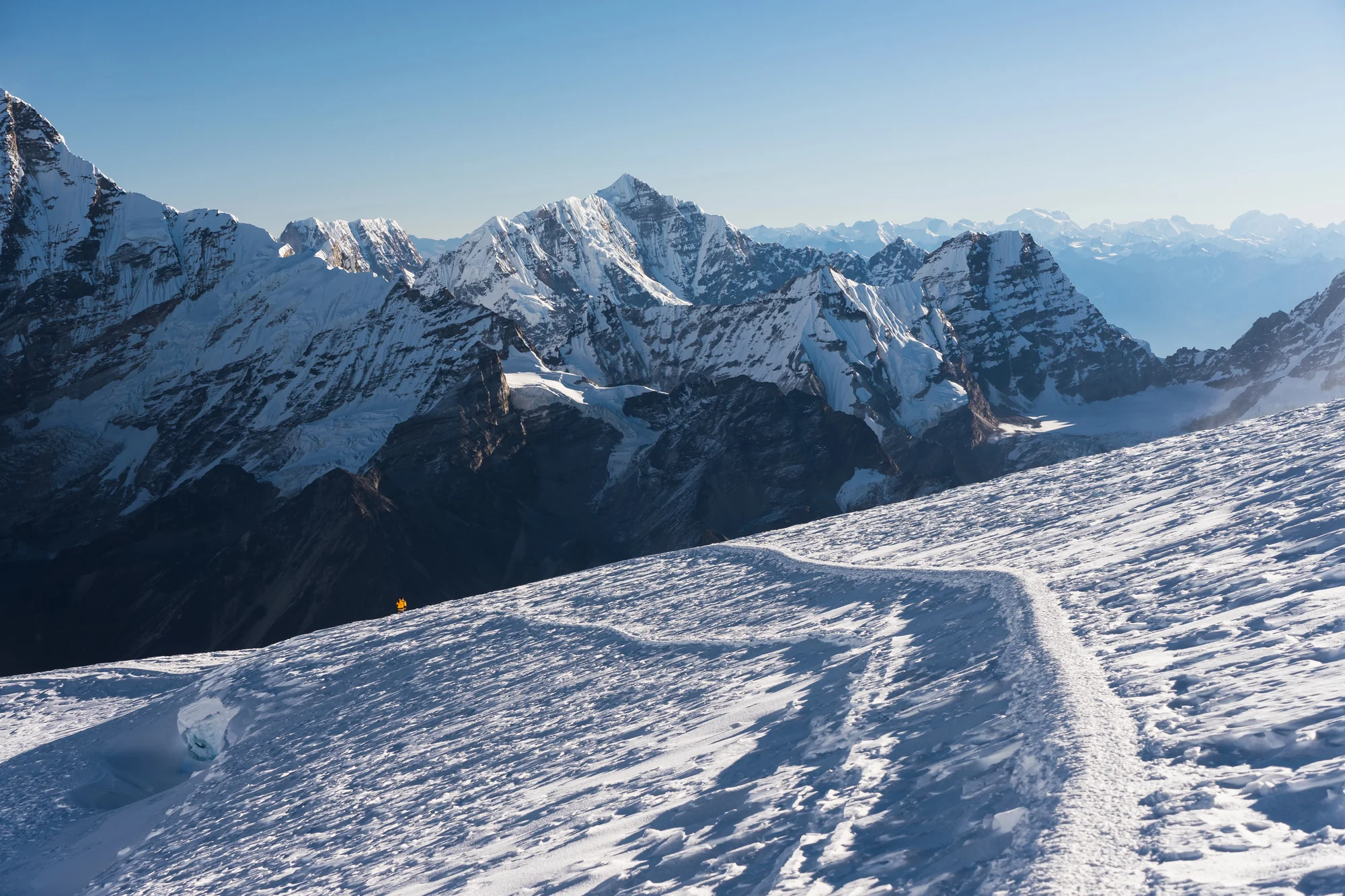
Island Peak / Imja Tse (6189 m) is one of Nepal’s most popular “trekking peaks”, but with one important caveat — unlike Mera Peak, the final section requires actual climbing: 100 m fixed ice wall at 45–55° + 200 m rock-snow ridge. This is not “just trekking”, this is alpinism at 6189 m. Popular as Everest expedition preparation — many climbers summit Island Peak days before Everest. This brief: 14–17 day profile, technical requirements, medical risks, kit.
Island Peak by the numbers
- Altitude: 6189 m (Imja Tse)
- Location: Khumbu, Nepal (near EBC trek)
- Typical length: 14–17 days (often combined with EBC trek)
- Summit success: 50–60% (lower than Mera due to technical difficulty)
- Technical difficulty: AD (assez difficile) — 100 m ice wall 45–55°, fixed ropes
- Required NMA permit: ~$250
- Requirements: jumaring ability, front-pointing crampon technique, safe movement on fixed lines
What differs Island Peak from Mera Peak
Technical difficulty
Mera Peak is a long glacier walk with gentle inclines. Island Peak has a “headwall” — a fixed ice wall impossible to bypass. Requires:
- Front-pointing (12-point crampons)
- Two technical ice axes (ice tools for fixed ice)
- Jumar (ascender), figure-8 or ATC
- Climbing harness + helmet
- Dynamic rope 30 m (usually team)
- Locking carabiners × 4
Altitude exposure time
Island Peak has shorter profile — overnight at High Camp (5500 m), summit push to 6189, return same day. Less time for full summit acclimatization. Therefore often combined with EBC trek (5364 m) — better acclimatization.
Specific medical risks
- Falls on ice wall — with fatigue at 6000+ m coordination declines, risk of detachment from line or slip
- Finger frostbite — jumaring and rope work in thin gloves, −15°C, −25°C wind chill
- HAPE from rapid ascent — if Island Peak without prior EBC or Mera acclimatization
- Avalanche in lower section — seracs above route, theoretical ice debris risk
- Exhaustion — summit day 12–16 h, combining technical effort + altitude
Typical 16-day profile (with EBC acclimatization)
- Day 1–2: Kathmandu → Lukla (2860 m) → Phakding (2610 m)
- Day 3: → Namche Bazaar (3440 m)
- Day 4: Namche — acclimatization day
- Day 5–6: → Tengboche (3860 m) → Dingboche (4400 m)
- Day 7: Dingboche — acclimatization day (Nangkartshang 5083 m)
- Day 8: → Chhukhung (4730 m) — Island Peak base
- Day 9: Chhukhung — rope technique training on glacier
- Day 10: → Island Peak Base Camp (5100 m)
- Day 11: → High Camp (5500 m)
- Day 12: Summit push (5500 → 6189 → Base Camp) — 12–16 h
- Day 13–16: Descent to Lukla, flight to Kathmandu
Medical kit — similar to Mera Peak
Kit identical to Mera Peak (acetazolamide, dexamethasone, nifedipine, antibiotics, NSAIDs) + additionally:
- Climbing gloves in 3 layers — thin merino + down intermediate + climbing GTX shell with thumb-gripper
- Chemical warmers — 10 per person for summit day
- Glacier glasses category 4 UV (highest) — intense ice reflection
- Dressings for minor injuries — crampon cuts, harness abrasions
- Lip balm and face ointment — cold + wind during fast climbing
Frequently asked questions
Is Island Peak a good first 6000-er?
Not for people without climbing experience. Island Peak requires actual skills: jumaring, front-pointing, fixed rope movement, safe ice wall crossing 45-55°. If first 6000-er — choose Mera Peak (simpler, higher). Island Peak is appropriate for: 1) climbers with alpine course + few ski-touring expeditions; 2) post-EBC trekkers wanting technical challenge; 3) Everest or Cho Oyu preparation.
How much does Island Peak expedition cost?
Commercial 14-17 day package with agency: $1800-3500 (depending on agency, lodge comfort, group size). Includes: NMA permit ($250), NMA guide, porter, lodge accommodation, trek meals, fixed glacier technical gear. Excludes: Kathmandu-Lukla flights (~$200 round-trip), tips ($200-400), personal insurance with helirescue ($80-250).
Can Island Peak be combined with Three Passes trek?
Yes, very popular combination for experienced. Three Passes (Kongma La 5535m, Cho La 5420m, Renjo La 5360m) give excellent acclimatization for Island Peak. Plan: 14-16 days Three Passes + 4-5 days Island Peak = 20-22 days total. Significant physical requirements: fitness for 10-14 h daily marching over 3 weeks, good alpine technique.
What if I can’t manage the ice wall?
First: Chhukhung training before attempt. Day 9 in program is dedicated to technique training in real conditions. If that day you have serious problems with jumaring or front-pointing — consider abort. Gentler alternative: descend from High Camp, head to Gokyo + Renjo La (safe 5360 m trek) and return to Namche. NMA guide helps with decision — don’t be ashamed to bail.
Island Peak vs Aconcagua — which to choose?
Different challenges. Island Peak (6189 m): lower, technically harder, shorter (2 weeks), more climbing, Himalayan climate. Aconcagua (6961 m): higher, no technical climbing, longer (3 weeks), more endurance, dry Andean climate. For first 6000-er with technical climbing: Island Peak. For first very high peak without climbing: Aconcagua. Advanced often do both as Seven Summits preparation.
References
- Nepal Mountaineering Association — Island Peak (Imja Tse) climbing statistics.
- Luks AM, Auerbach PS, Freer L, et al. Wilderness Medical Society Clinical Practice Guidelines: 2019 Update. Wilderness Environ Med. 2019;30(4S):S3–S18.
- Himalayan Database — Island Peak expedition records.
Disclaimer: Island Peak is technical climbing requiring alpine course and experience. In Nepal NMA guide mandatory. Emergency: Himalayan Rescue Association +977-1-4427044.