


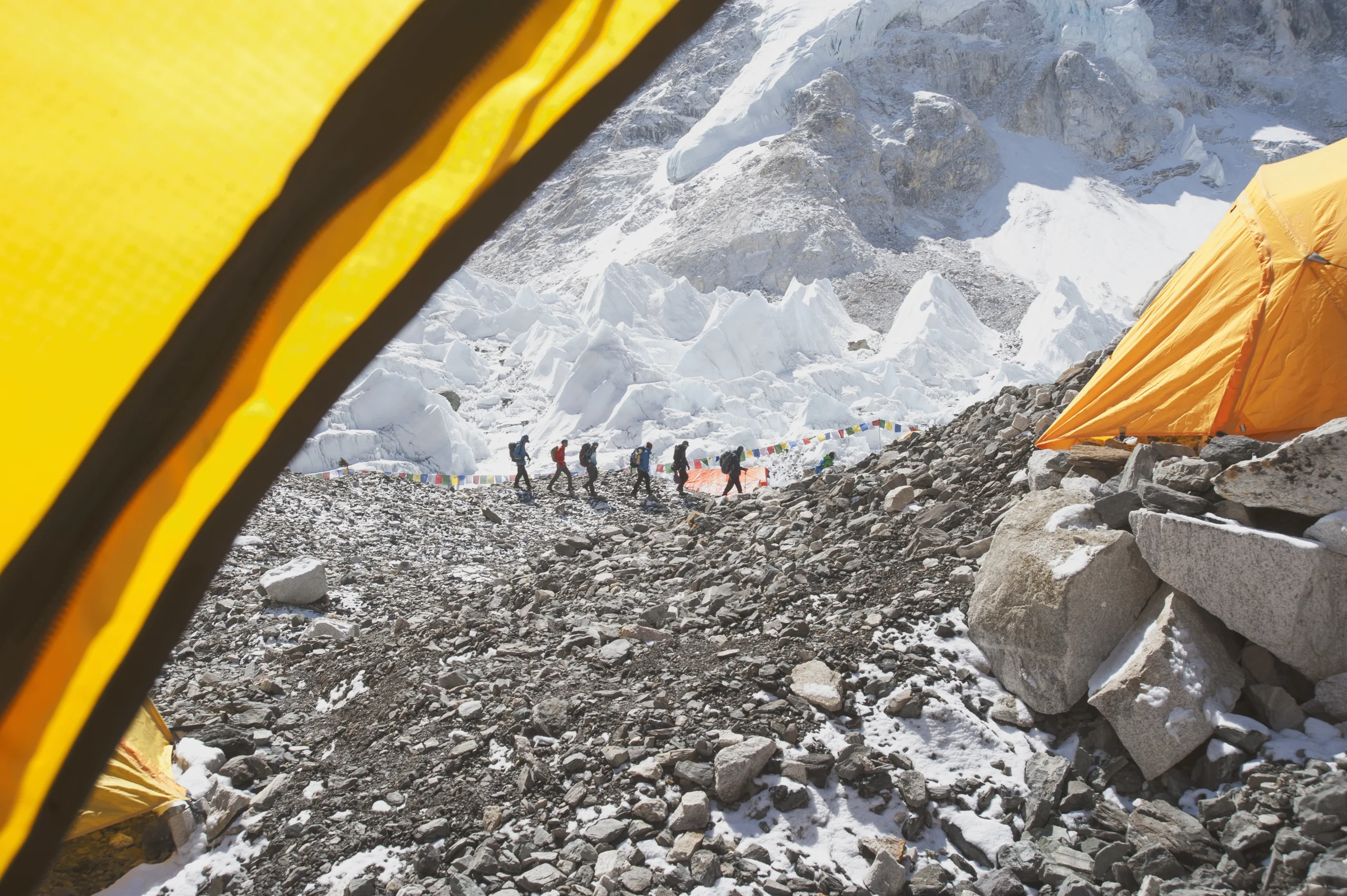
Acclimatization is a series of physiological changes that allow tolerance of lower oxygen availability at altitude. It’s not a permanent trait you can develop once — you must re-acquire it before every expedition, because most changes fade within 4–6 weeks of return. In mountain medicine several “golden rules” of acclimatization exist based on decades of observation — this article covers understanding and proper application: the 300–500 m rule, “climb high, sleep low”, rest day after every 1000 m.
Golden rules of acclimatization
- 300–500 m/day rule — above 3000 m don’t increase sleeping altitude faster
- Climb high, sleep low — during the day go higher, but sleep at lower altitude
- Rest day after every 1000 m — overnight at the same altitude for an additional night
- Hydration 3–6 L/day with electrolytes, monitor urine color
- Avoid alcohol and strong sedatives — depress the respiratory center
- Monitor symptoms daily — saturation + Lake Louise Score assessment
Why exactly 300–500 m per day?
This number is not arbitrary — it comes from decades of clinical observation in Himalayan and Andean base camps. The rule states: above 3000 m do not increase SLEEPING altitude faster than 300–500 m/day. The key is “sleeping” — it’s not daytime walking pace that matters, but where you sleep.
Physiologically: during 12–18 h of overnight rest the body gradually increases minute ventilation, produces more erythrocytes, adjusts acid-base balance. A jump >500 m in one day overloads these mechanisms — hence increased AMS, HAPE, HACE frequency in people breaking this rule. A 2023 RCT meta-analysis showed: trekkers increasing altitude by 700+ m/day have 2.8× higher AMS risk than those maintaining 400 m.
“Climb high, sleep low” — practical application
This rule complements the 300–500 m rule. Allows “touching” higher altitude without increasing AMS risk — because you don’t sleep at that altitude.
Examples of correct profile
- EBC trek — Namche day: overnight 3440 m, day trip to Everest View Hotel (3880 m), return to 3440 m = “climb high 440 m, sleep low”
- Dingboche: overnight 4400 m, day trip to Nangkartshang (5083 m), return = “climb high 680 m, sleep low 680 m”
- Aconcagua rotation: Plaza de Mulas 4300 m → carry to Canada Camp 5050 m → return to 4300 m for night
Physiologically the body “remembers” this higher exposure — produces erythropoietin, increases ventilation, these changes persist 24–48 h. Next day you can already sleep at 4500 m (per 300–500 m rule) with better tolerance.
Rest day — after every 1000 m
Compromise rule: above 3000 m after every 1000 m of altitude gained — additional night at the same altitude. Doesn’t mean full tent rest; during the day worth short acclimatization activity (“climb high, sleep low”).
Rest day placement examples
- Sleep at 3000 m (Namche 3440) — 1 rest day
- Sleep at 4000 m (Dingboche 4400) — 1 rest day
- Sleep at 5000 m (Lobuche 4940, Khare 5000) — 1 rest day
- Sleep at 6000 m (Khare High Camp 5800, C3 Aconcagua 5900) — rotation (return overnight to 5000 m)
Hydration — exactly how much and what
Altitude increases water loss through: 1) breathing — cold dry air dries lung mucosa, 2) skin — low humidity in Andes/Himalayas, 3) accelerated breathing — compensatory hyperventilation, 4) altitude diuresis — kidneys excrete excess bicarbonate.
Recommendations
- 3–4 L/day at 3000–4000 m
- 4–5 L/day at 4000–5000 m
- 5–6 L/day at 5000+ m
- 6–8 L/day in dry Andes climate (Aconcagua) or during summit push
Urine observation — practical indicator
- Clear or straw-colored — OK, properly hydrated
- Dark yellow — add electrolytes and drink more
- Amber or darker — significant dehydration, drink 1 L immediately + continue increased intake
- Minimal amount — severe dehydration, if persisting — consider descent
What to avoid during acclimatization
- Alcohol — depresses respiratory center, worsens nocturnal hypoxia, increases dehydration
- Strong sedatives (benzodiazepines, opioids) — same mechanism, disrupt nocturnal ventilation
- Intense exercise on acclimatization days — increases oxygen demand, overloads compensatory mechanisms
- Intentional dehydration — “drink less = fewer toilet trips” is an error, dehydration significantly raises AMS risk
- Ignoring AMS symptoms — “just a headache, going higher” — most common cause of progression to HAPE/HACE
Pre-expedition acclimatization — is it worth it?
Hypoxic tents
Sleeping at simulated 2000–2500 m for 2–4 weeks before expedition brings documented effect — meta-analyses show 20–30% AMS reduction and better fast-ascent tolerance. Requirement: minimum 14 h/day exposure. Limitation: simulates only lower oxygen percentage, not actual atmospheric pressure (which is the real cause of altitude hypoxia).
Acclimatization peaks in the Alps
A week before Kilimanjaro or Aconcagua spent in the Alps at 3000–4000 m (Mont Blanc du Tacul, Gran Paradiso, Weissmies) gives real acclimatization to ~4000 m. Effect persists 2–3 weeks — ideal if you fly directly to expedition after descent.
Endurance training — does NOT replace acclimatization
Common myth: “if I’m fit, I won’t get AMS”. Aerobic fitness and acclimatization are two different processes. Endurance athletes have wide aerobic reserves but their bodies aren’t automatically acclimatized — they often suffer AMS more than average trekkers, because ambition pushes them too fast up altitude.
The 300–500 m rule — exceptions and controversies
When can you safely break it?
- Descent — can drop as fast as wanted, no risk
- Between 2000 and 3000 m — below AMS threshold, rule not strict
- After full acclimatization — people who spent a week at 5000 m can safely go to 6000 m
- Good daily indicators — SpO₂ >85%, no AMS, stable wellbeing for 2 consecutive days allows larger step
When you CANNOT break it?
- First 3–4 days above 3000 m — acclimatization mechanisms not yet developed
- History of AMS/HAPE/HACE — significantly higher risk even with standard profile
- Suspected concurrent illness — cold, infection, dehydration — lowers tolerance
- Moderate or severe AMS symptoms — absolutely don’t increase altitude
Frequently asked questions
How long does full acclimatization take?
Depends on altitude. To 3000 m — few days. To 4000 m — 1-2 weeks. To 5000 m — 2-4 weeks. To 6000+ m — never fully; only partial, with progressive weight loss and exhaustion. Rule: full acclimatization to given altitude takes about twice as long as reaching it (if using 300-500 m rule).
Does acclimatization persist between expeditions?
Partially. Increased erythrocyte counts persist 4-6 weeks. Metabolic changes (mitochondrial efficiency) 2-3 weeks. After 6 weeks back at sea level — practically full reset, must acclimatize again. Exception: genetic polymorphisms (Tibetans, Sherpas) give permanent better tolerance, but lowland dwellers can only achieve short-term acclimatization.
Can I go to high mountains during pregnancy?
Below 3000 m — safe for most low-risk pregnancies. 3000-4000 m — with caution, gynecological consultation. Above 4000 m — generally advised against (no definitive data, but hypoxia may affect placental development). Women with prior miscarriages, pregnancy hypertension or other risk factors — below 3000 m. Gynecological consultation 4-6 weeks before expedition.
Do children acclimatize like adults?
Worse. Children 3500 m in children <10-12. For youth 12-16 gradual introduction with longer acclimatization days than adults. Always consult pediatric expedition medicine.
How to check if I’m acclimatized?
Four indicators: 1) Resting morning SpO2 >85% (or >80% above 5000 m) – stable for 2 consecutive days; 2) No headache, sleep disturbances, appetite loss; 3) Normal or slightly reduced exercise tolerance (can walk at normal pace); 4) Urine amount and color normal. Subjective wellbeing is MOST IMPORTANT – if you feel well and indicators are stable, you’re acclimatized to that altitude. No single ‘acclimatization test’ – it’s a state of many factors.
References
- Luks AM, Auerbach PS, Freer L, et al. Wilderness Medical Society Clinical Practice Guidelines: 2019 Update. Wilderness Environ Med. 2019;30(4S):S3–S18.
- Luks AM, Ainslie PN, Lawley JS, et al. Ward, Milledge and West’s High Altitude Medicine and Physiology, 6th ed. CRC Press, 2021.
- West JB. Physiological effects of chronic hypoxia. N Engl J Med. 2017;376(20):1965–1971.
- Hackett PH, Roach RC. High-altitude illness. N Engl J Med. 2001;345(2):107–114.
Disclaimer: Acclimatization rules are statistical recommendations — individual reactions vary. First high-altitude expedition requires consultation with an expedition medicine physician.