


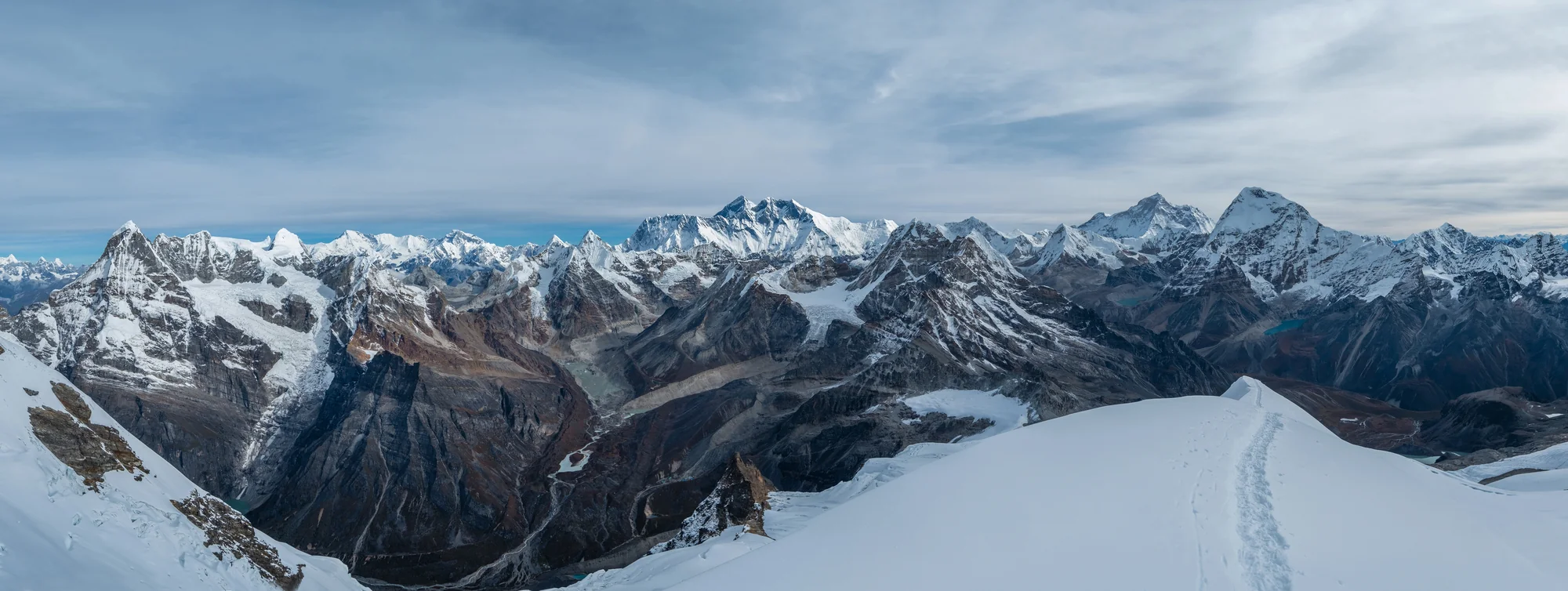
Mera Peak (6476 m) is classified as a Nepal “trekking peak” — technically the simplest 6000-er in the Himalayas, achievable without fixed lines and rope climbing. It’s popular as a “first 6000-er” for trekkers after EBC or Annapurna. Medically, however, it is still 6476 m with all risks of HAPE, HACE, hypothermia, and glacier crossing. This brief: 18–22 day acclimatization profile, what differs Mera Peak from EBC trekking, 6000-er medical kit.
Mera Peak by the numbers
- Altitude: 6476 m (Mera Central)
- Location: Solukhumbu, Nepal, south of Everest
- Typical length: 18–22 days (from Lukla)
- Summit success: 70–80% (highest among Nepal 6000-ers)
- Technical difficulty: PD (peu difficile) — gentle glacier, last 200 m with fixed lines
- Required permit: NMA (Nepal Mountaineering Association) — ~$250
What differs Mera Peak from EBC trek
- Higher maximum altitude: 6476 m vs 5643 m (Kala Patthar) — significant HAPE/HACE risk jump
- Overnight at 5800 m (High Camp) instead of 5364 m (EBC) — longer extreme altitude exposure
- Summit push on glacier — requires crampons, ice axe, team rope
- Three nights above 5000 m (Khare 5000, High Camp 5800, possibly Thuli Kharka 4300)
- Less crowded — trail less popular than EBC, more solitude
My own first 6000-metre peak looked much the same: Lobuche East, climbed during a two-month stay at Everest Base Camp, after weeks spent above 5000 m. Acclimatization carried over from a trek genuinely works for a summit like this — but it holds for a few weeks at most, so the next expedition means building it from scratch.
Specific medical threats
- HAPE — elevated risk due to 5800 m overnight (High Camp); ~5–8% of participants
- HACE in 1–2% of climbers — usually after ignoring AMS signs at Khare (5000 m)
- Finger frostbite — night/pre-dawn summit push, −15 to −25°C
- Energy exhaustion — summit day 10–14 h moving, +700 m and −700 m
- Glacier accidents — rare, but crevasse falls do happen on final stretch to summit
20-day standard acclimatization profile
- Day 1: Kathmandu → Lukla (2860 m), trek to Chutanga (3100 m)
- Day 2–4: Over Zatrwa La (4600 m) to Kothe (3700 m), Thuli Kharka (4300 m)
- Day 5–7: Thangnag (4350 m), acclimatization days
- Day 8–10: Khare (5000 m), 2 acclimatization nights with rotation to Mera Glacier
- Day 11: Khare → Mera La (5415 m) → Base Camp (5300 m)
- Day 12: Base Camp → High Camp (5800 m)
- Day 13: Summit push (5800 → 6476 → 5800) — 10–14 h
- Day 14–18: Descent to Lukla
- Day 19–20: Reserve + flight Lukla → Kathmandu
Frequently asked questions
Mera Peak for post-EBC trekker?
Yes, classic next step after EBC. First 6000-er with minimal technical difficulty (crampons, ice axe, team rope on glacier), but 6476 m altitude means higher AMS/HAPE/HACE risk than EBC 5364 m. Requirements: weekend alpine course minimum, physical fitness (10 km run in 1 h), prophylactic Diamox from 24 h before 4000 m.
Mera Peak vs Island Peak — which to choose?
Mera Peak (6476 m) — easier technically, longer approach, higher summit, higher altitude. Island Peak (6189 m) — harder technically (permanent ice and rock section at summit), shorter approach, lower summit. For first 6000-er after EBC: Mera Peak (simpler technique). For experienced climber: Island Peak (more adrenaline).
Is guide required on Mera Peak?
Since 2023 in Nepal guide is MANDATORY for foreign tourists on all treks and climbs. Cost: guide ~$30/day + porter ~$20/day. On Mera Peak an NMA-qualified guide knows the route, glacier conditions, and has rescue contacts. Solo climbing is illegal.
Pharmacological prophylaxis on Mera Peak?
Standard: acetazolamide 125 mg twice daily from 24 h before 4000 m (Thuli Kharka), continued until descent. For HAPE history: additionally nifedipine retard 20 mg twice daily from Khare (5000 m). Dexamethasone: only in rescue kit (tablets + ampoule), not prophylactically. Kit also must: ibuprofen, paracetamol, azithromycin, loperamide, ORS.
Most common Mera Peak failure causes?
1) Bad summit-day weather (winds, snowstorm) — 15–20% abandonment. 2) AMS/HAPE forcing descent — 10–15%. 3) Physical exhaustion summit day — 5–10%. 4) Finger frostbite halting progress — 3–5%. Total success rate 70–80% (highest among Nepal 6000-ers), mainly thanks to long acclimatization and low technical difficulty.
References
- Nepal Mountaineering Association — Mera Peak climbing statistics.
- Luks AM, Auerbach PS, Freer L, et al. Wilderness Medical Society Clinical Practice Guidelines: 2019 Update. Wilderness Environ Med. 2019;30(4S):S3–S18.
- Basnyat B, Murdoch DR. High-altitude illness. Lancet. 2003;361(9373):1967–1974.
Disclaimer: Since 2023 climbing in Nepal requires NMA guide. Emergency: Himalayan Rescue Association +977-1-4427044.